Services
Innovation Management
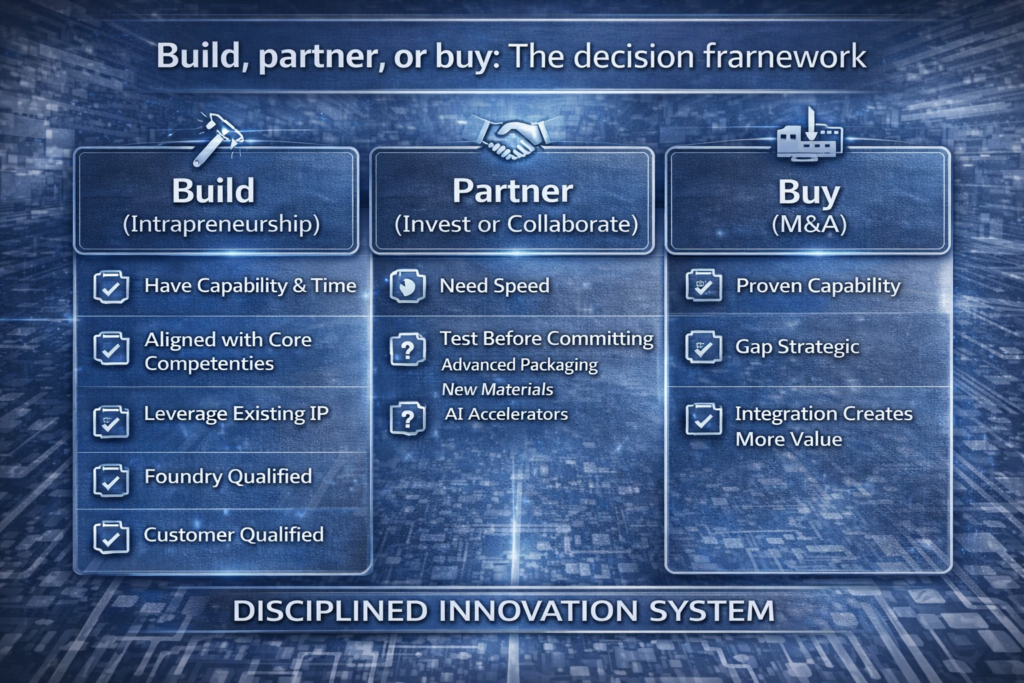
Systematically turns IP into scalable products by balancing intrapreneurship, external ventures and M&A under fast-track governance that protects quality while accelerating OEM-ready commercialisation
R&D and Product Acceleration
Close gaps from concept to manufacturing readiness. Reduce rework, speed verification and align pipelines with production to shorten time-to-market for fabless and mixed-signal teams
Opportunity and Product Management
Turn project work into scalable products, improve portfolio strategy, pricing and go-to-market and support technical marketing and sales enablement
Innovation Management
European high/deep-tech SMEs are at a critical inflection point: global competition is accelerating, manufacturing and scale advantages sit largely in Asia and the US, and public funding programs (e.g., EU Chips Act and related national/EU instruments) reward ambitious innovation, but also demand execution discipline and measurable industrial impact. Across semiconductors, photonics, advanced materials, industrial automation, medtech, climate/energy hardware, robotics, and other deep-tech domains, the recurring challenge is the same: translating research excellence into repeatable productization, qualification, and scalable operations without diluting technical rigour.
- Europe leads in research output, but often underperforms in commercialization, scale-up, and global go-to-market execution.
- Funding opportunities exist, but many SMEs lack the operational maturity, governance, and evidence packages required to win and deliver programs credibly.
- Qualification and adoption cycles are long (often 18–36 months in regulated or OEM-driven value chains), which strains runway, planning, and iteration speed.
- Competitors benefit from vertical integration, faster industrial learning loops, and tighter coupling between R&D, manufacturing, and supply ecosystems.
- Demographic/succession pressure in parts of the European industrial supply chain creates capability gaps and continuity risk.
- Talent scarcity in specialized engineering, industrialization, quality/regulatory, and systems roles becomes a growth bottleneck precisely when speed matters most.
How I can help
- Establish an innovation portfolio and governance model that balances exploration vs. exploitation, with clear decision rights, stage gates, and “stop/scale” criteria.
- Translate research outputs into product roadmaps: target use-cases, value propositions, measurable requirements, and a milestone plan that investors/OEMs can underwrite.
- Implement a disciplined experiment-to-evidence loop (hypotheses, test plans, acceptance thresholds, documentation) to reduce wasted cycles and make progress auditable.
- Build the industrialization path early (supply chain, manufacturing route, test/verification, quality plan) so scale-up is designed in, not patched on after prototypes.
- De-risk adoption through qualification readiness: structured customer pilots, validation data packages, compliance/regulatory mapping (where relevant), and partner alignment.
- Strengthen funding readiness and execution: program narrative, work-package structure, KPI system, consortium/partner roles, and operational cadence for delivery.
- Create scalable cross-functional ways of working (R&D, product, operations, commercial) to protect focus, speed decisions, and retain technical rigor as the organization grows.
R&D and Product Acceleration
Teams lose time in the handoffs from concept to verification, layout, test, packaging, and manufacturing readiness ... where requirements drift, DFM/DFT constraints surface late, mixed-signal verification becomes a bottleneck, and production/test strategies aren’t defined early enough. The result is rework, respins, longer bring-up, and delayed ramps.
I help close this gap by front-loading risk (early DFM/DFT/packaging and cross-domain reviews), accelerating verification with the right-fidelity strategy, and aligning test + characterization plans to cost and ramp needs. I also introduce clear readiness gates, reusable checklists, and disciplined release packages so partners execute consistently and teams shorten time-to-market with higher first-pass success.
How I can help
- Concept-to-production readiness framework (clear gates, artifacts, and owners)
- Front-load risk with “early sign-off” and cross-domain reviews
- Verification acceleration: right fidelity at the right time
- Test and characterization strategy aligned to cost and ramp needs
- Release package discipline (traceability + reuse)
- Pipeline alignment with manufacturing partners

Opportunity and Product Management
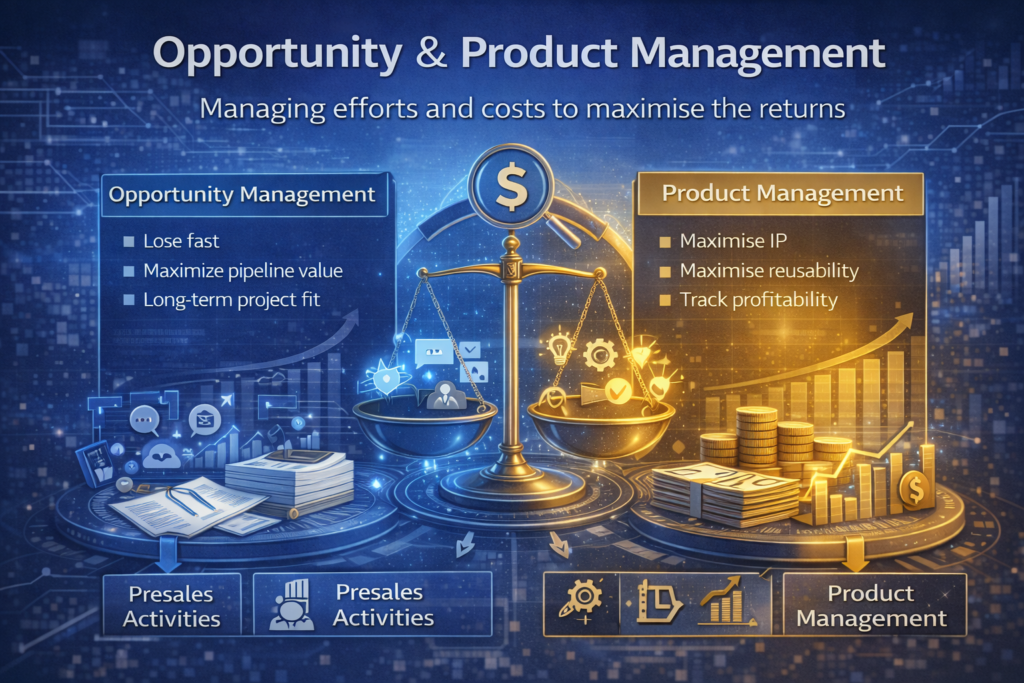
In many organizations, opportunity pursuit becomes a silent drain: presales, solutioning, and custom roadmap discussions consume scarce engineering and product capacity, often without a clear view of win probability, true delivery cost, or the impact on committed programs. The hidden cost isn’t just the spend to compete, but the opportunity cost of delayed releases, missed quality targets, and reduced focus on customers you’ve already won. While you can’t control when a deal will be awarded, you can control the discipline of when to stop investing and when to double down, with decisions based on evidence, not momentum.
How I can help
- Define a gated opportunity lifecycle with clear entry/exit criteria (what must be true to proceed from qualification to solutioning to proposal to commit).
- Build a practical scoring model for win probability, strategic fit, margin, and delivery risk (including “cost to serve” and engineering effort).
- Introduce “kill rules” and escalation triggers to stop low-quality pursuits early (and protect delivery commitments).
- Separate presales experimentation from product commitments using lightweight governance (what can be promised, by whom, and with what proof).
- Align product/engineering capacity planning with the funnel so opportunity work is time-boxed, staffed intentionally, and doesn’t cannibalize execution.
- Establish decision forums and artifacts (one-page opportunity brief, risk register, assumption log) to reduce churn and improve accountability.
- Improve post-mortems on wins/losses to continuously calibrate scoring, sharpen qualification, and increase hit-rate over time.
Regulations & Funding
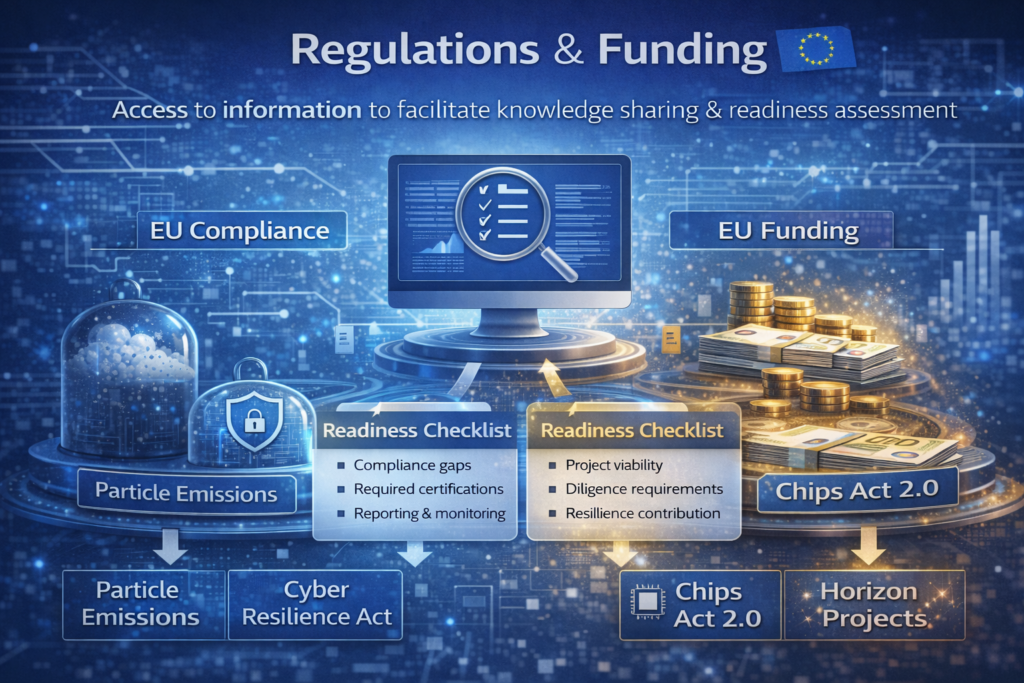
SMEs face a dual pressure: regulatory obligations are expanding in scope and enforcement, while public funding is increasingly competitive and execution-heavy. New rules such as the Cyber Resilience Act introduce product-level security and lifecycle requirements (secure-by-design, vulnerability handling, documentation and evidence), while environmental constraints such as particle emissions standards add additional testing, reporting, and supply-chain scrutiny. For deep-tech SMEs, these demands arrive when teams are already resource-constrained and still iterating on product-market fit.
At the same time, accessing mechanisms like EU Chips Act 2.0 and Horizon projects requires more than a strong technical idea. SMEs must show industrial credibility: clear use-cases, quantified impact, mature work plans, risk management, partner commitments, and the ability to deliver measurable outcomes on schedule. This creates a coordination challenge—building the right consortium and traction with OEMs, suppliers, labs, and integrators while also keeping day-to-day execution on track and staying compliant.
Typical challenges include:
- Continuous monitoring of fast-moving regulatory requirements and translating them into concrete product, process, and documentation changes.
- Generating auditable evidence (security processes, test results, traceability, supplier controls) without slowing engineering velocity.
- Managing multi-party supply chains where compliance depends on upstream components, tooling, and third-party software.
- Balancing scarce talent and budget between compliance work and the activities that drive revenue and customer adoption.
- Building credible partnerships and traction early enough to qualify for funding calls, while avoiding “consortium overhead” that distracts from delivery.
- Meeting funding expectations around governance, KPIs, reporting, and commercialization plans.
How I can help
- Set up a lightweight regulatory radar (sources, cadence, owners) and translate new requirements (e.g., CRA, environmental/particle constraints) into a clear internal action plan and timeline.
- Build compliance-by-design practices that fit SME reality: security and sustainability requirements mapped to product requirements, engineering checklists, and “evidence packs” without excessive overhead.
- Define what needs to be true for auditability: documentation structure, traceability from requirements to tests, supplier/component information, and vulnerability/issue handling workflows.
- Align product, quality, and supply chain so compliance doesn’t break delivery: role clarity, partner expectations, and early identification of gaps that would block certifications, OEM acceptance, or funding.
- Make funding readiness concrete: shape a compelling project narrative, measurable KPIs, work packages, risk plan, and a credible exploitation/commercialization path.
- Orchestrate the right partnerships: identify missing capabilities, structure consortium roles, secure commitments, and set a delivery cadence that keeps consortium work from derailing operations.